

Strategy
8 min read
In a crowded exhibition hall, your booth only exists if it can be seen from a distance. The upper zone of your structure—whether a hanging sign, a totem, or a vertical element—is the first signal you send before any conversation even begins. Here is how to truly make the most of it.



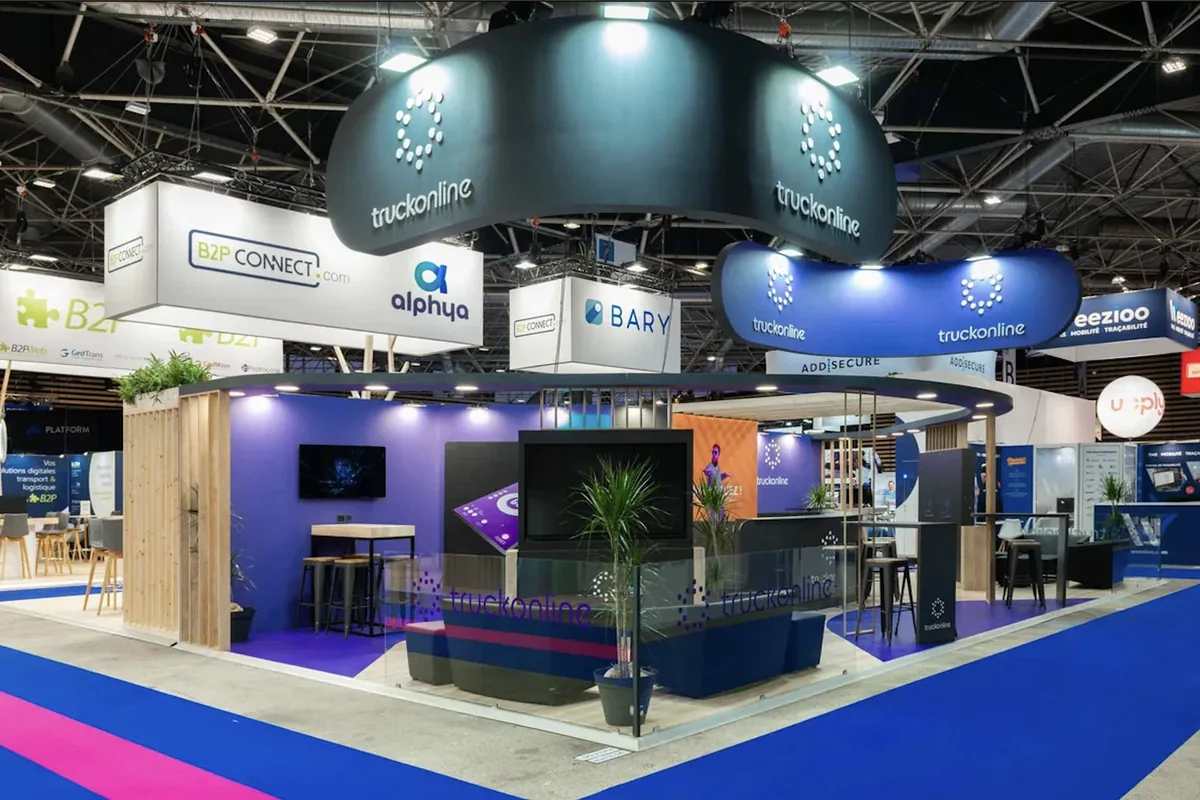
In an exhibition hall, everything at eye level tends to blend together. Booths look alike, aisles intersect, and visitors walk through with their heads down, rarely looking up. What stands out—what visually breaks through—is what rises above the rest. The upper zone of a booth is precisely that part of the structure that climbs above neighboring stands, becoming your first visual signal before any interaction takes place.
This signal acts like a lighthouse. The visitor hasn't decided to come your way yet, but they have spotted you. This recognition triggers an unconscious decision: this booth exists, it has a presence, it might be worth a visit. Without this height, your booth has to wait for the visitor to reach its level to exist. With it, you attract them from the other end of the aisle. It is an advantage that multiplies contact opportunities without your team having to lift a finger.
What a visitor perceives from afar—before the message, before the product, before the team—is the visual stature of the booth. A booth that rises high with a clean structure and a legible logo sends an immediate signal: this brand is serious, it has invested, and it is here for real. A booth with a uniform height and no notable vertical elements can come across as a second-tier exhibitor, even if the offering is excellent.
The upper zone is a signal of credibility before it is a communication tool. This is why major brands use it systematically: they know that perception is formed in seconds and that it dictates the rest of the exchange. This is not a prestige expense. It is the entry cost for a presence that counts. And this cost is an integral part of the booth budget, just like the structure or the furniture: what you are really paying for your booth per square meter actually includes these items that many underestimate during the quoting phase.
Height is only useful if it carries a legible message. A high structure with a blurry or undersized logo is like waving a white flag: you signal your presence without saying who you are. A hanging sign is the most effective solution for medium to large booths: it is visible from all angles, frees up floor space, and allows you to work with typography and color contrast for maximum readability from a distance.
For more compact booths, totems or vertical elements serve the same purpose while taking up less space. A 3 to 4-meter totem with a clear message at the top and integrated lighting is enough to exist visually in a hall. It is not a question of booth size, but of the intelligent use of the vertical axis. Architectural height elements (arches, gantries, L-shaped structures) can also define the space while serving as visibility supports, provided they do not block the booth entrance from the aisle. The choice between these options depends directly on the open or closed configuration of the booth : on a semi-open booth, the upper zone becomes even more important because it compensates for the reduced visibility at the facade level.
A high-level sign visible from only one side is only useful to visitors arriving from that direction. At a trade show, traffic flow is multidirectional: visitors arrive from the entrance, double back, and cut through cross-aisles. The high-level area of a booth must be effective from multiple angles, ideally from all four main sides if the floor space allows.
This implies three concrete decisions:
- logo orientation must be designed for main traffic axes, not just for the booth photo that will go on the website.
- lighting for the high-level area must be present and aimed to ensure readability even when the hall's ambient light is bright or varies throughout the day.
- long-distance readability must be tested: if you cannot read your brand name from ten meters away on a mockup or test print, it will not be readable from fifty meters away in the hall. The rule of thumb is that the minimum size of text or a logo on a high-level sign should be calculated based on the target viewing distance, not the surface area available on the structure.
This logic of long-distance visibility is also directly linked to the location chosen at the trade show : a good location amplifies the reach of the high-level area, while a bad location cancels it out. The two decisions must be made together.
The high-level area is not just design. It is a visibility lever. It determines whether your booth exists in the visitor's consciousness before they are within earshot of your team. Treating this decision as an aesthetic choice at the end of a project is like building a high-performance booth and hiding it behind an invisible facade. In a crowded hall, height is your first point of contact. It deserves to be prepared as such.
There is no universal rule, but an effective sign should be at least 50 cm to 1 meter higher than standard neighboring booths. In practice, the most effective hanging signs are between 4 and 5 meters high, depending on trade show regulations and the hall's ceiling height. This must be verified with the organizer before finalizing the design.
No. Each trade show sets its own maximum height rules, which vary by hall and sometimes by booth size. These constraints must be checked before the design phase, not after. A booth plan designed outside of regulatory limits may be rejected during setup.
A hanging sign offers 360-degree visibility and frees up floor space, but it requires ceiling rigging points provided by the organizer, which are often charged as an extra. A totem is more autonomous and suitable for smaller spaces, but its visibility is directional. For booths over 20 m², a hanging sign is generally the most effective choice if the budget and regulations allow.
Yes, and often even better, because a small booth needs to compensate for its limited footprint with a strong vertical presence. A well-designed totem on a 9 m² booth can have more impact than a low-level sign on a 30 m² booth without any vertical elements.
By printing or displaying the mockup to scale and viewing it from the target reading distance. If the name isn't readable at a glance from ten meters away on an A4 print, it won't be from fifty meters away on the actual sign. Lighting should also be simulated: a dark logo on a dark background will disappear in a hall with high ambient lighting.
Article header photo: booth Truckonline created by the AUKARÉ agency
Are you still here? Good news. We’ve got more to share with you. Short, to-the-point articles, written for those who are preparing for a trade fair and setting up their stand but don’t have time to read novels.




@2026 AUKARÉ all rights reserved.