

Strategy
7 min read
Generating qualified leads at a trade show requires much more than a visible booth and a smiling team. Trade show lead capture is a discipline in its own right that must be prepared in advance, structured within the physical setup, and extended into the CRM post-event. Yet, the majority of B2B exhibitors leave with poorly qualified contact lists and disappointing conversion rates. Every square meter of your booth should be treated as a commercial asset, not a passive communication tool. That is the difference between a booth that impresses and a booth that converts. Here are 6 concrete levers to change your results on the show floor.



Before briefing your agency, formalize measurable goals: number of qualified leads expected, target visitor profile (decision-maker, influencer, user), and the action to trigger (demo, meeting, order). Without this clarity, booth design remains a purely aesthetic decision.
Definition: What is a qualified lead at a trade show? A qualified lead is a contact whose profile matches your ICP (Ideal Customer Profile), who expresses an identified need, and has a known budget and decision-making timeline. Any other contact is a prospect to be nurtured.
Read also: 3 mistakes in the booth design brief
A technical director responds to different stimuli than a buyer or a CIO. Building exhibitor personas, 2 to 3 profiles maximum, dictates the messaging on your signage, the layout of your demo zones, and the qualification script used by your sales teams.
Persona example: the busy buyer
Profile: CEO of an SME with 50-200 employees, 15 minutes of availability, comparing 3 solutions. What they want: immediate quantified ROI, social proof (client references), ease of implementation. What your booth must offer: a value proposition readable from 10m away, a 5-minute express demo area, a concise takeaway document.
A booth layout optimized for trade show lead capture features three distinct zones, each with a specific business objective:
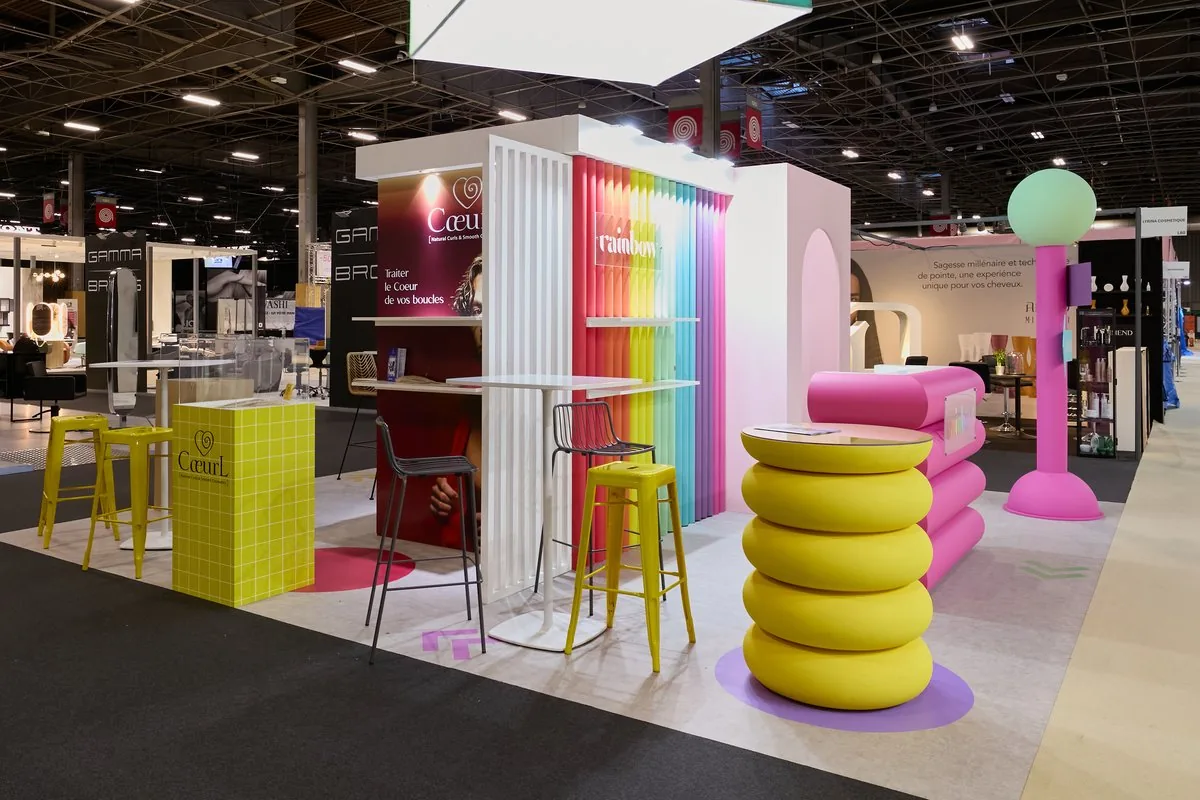
A fully enclosed booth filters too much and discourages spontaneous entry. A booth that is too open drowns the team in unqualified traffic. The semi-open configuration (visual invitation at the entrance, recessed discussion area) is the most effective format for B2B events to combine high contact volume with quality interactions.
Thebadge scanner app provided by the organizer scans contact data but does not qualify it. It must be systematically supplemented with a manual or voice note at the time of the scan: level of interest, nature of the need, and next steps.
Key takeaway: the badge scanner app is a volume tool. The mobile CRM is a qualification tool. Both are essential; without each other, you end up with either data or insights, but rarely both.
Implement a simple scoring system that is shared and understood by every team member:
The quality of trade show lead capture depends above all on the people at the booth. A booth brief for the teams includes: priority visitor personas, qualification questions to ask systematically (budget, timeline, decision-maker, competitors in the pipeline), scoring protocol, and instructions for using digital tools.
Hook (30 seconds): identify the visitor's context without jargon: "Are you exhibiting or visiting? What kind of problem are you looking to solve this year?"
Qualify (2–3 minutes): the two key questions: "Do you already have a budget allocated for this?" and "Who makes the final decision at your company?"
Direct (immediate): to the demo area, an in-depth interview, or a scheduled post-event meeting. Never let an A-lead leave without a set next step.
Key data: lead conversion rates drop by 80% if the first follow-up happens after 48 hours. Most B2B exhibitors reach out 7 to 14 days after the event. This is when qualified leads are lost to more responsive competitors. 80% of generated leads never convert into customers as explained by Simple CRM club in their article.
A booth designed to convert cannot be improvised at the technical brief stage. The trade show booth design agency must integrate your business objectives from the very first sketches: placement of digital capture points, ergonomics of meeting areas, visitor flow signage, and engagement tools.
Agencies like AUKARÉ work upstream on thetrade show brand experience and the requirements of visitor journey. Every design decision—façade openings, partition heights, reception desk placement—is weighed based on its impact on the conversion rate expected, rather than solely on aesthetic criteria.
Turning a trade show booth into a lead-generation machine requires action on three levels simultaneously: the physical design of the setup, the sales team's methodology, and the post-event follow-up process. These three levels are interdependent; optimizing one without the others will only yield partial results. Your next step: audit your last trade show using this framework and ask yourself these questions: how many A-leads were collected, how many were followed up within 48 hours, and how many were converted into opportunities? The answers will define where to focus your efforts for the next event. Shall we discuss your next booth ?
Are you still here? Good news. We’ve got more to share with you. Short, to-the-point articles, written for those who are preparing for a trade fair and setting up their stand but don’t have time to read novels.





@2026 AUKARÉ all rights reserved.