



Strategy
7 min read
The question comes up in every trade show brief: should you choose a custom booth or a modular one? On the surface, the answer seems obvious. In reality, the distinction is far more nuanced than a simple choice between original and standardized. Here is what you need to understand before you decide.



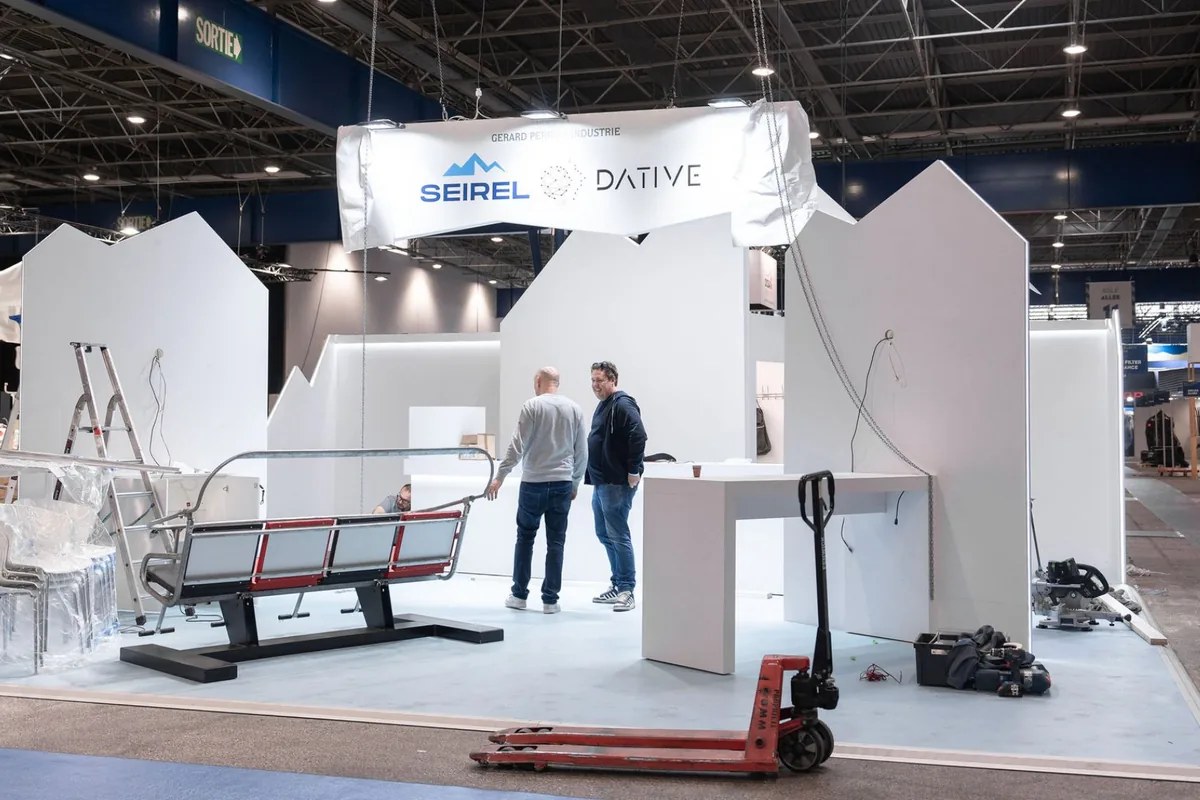
When they hear "modular booth," many exhibitors imagine interchangeable white partitions—a soulless stand thrown together in a hurry. That image belongs to a bygone era.
Today, a well-designed modular booth can be just as visually impactful as a fully custom one. The difference isn't in the aesthetics. It lies in the manufacturing logic and the strategy behind it.
A modular booth of high quality is tailor-made for your brand, with components designed to be reassembled differently depending on the show, the floor space, and the layout. The keyword isn't modular; it's reconfigurable.
A custom booth is designed and manufactured specifically for a precise project, without the constraints of standardization. Every element is conceived for a specific show, a specific floor space, and a specific objective.
This offers total creative freedom. Atypical shapes, premium materials, ambitious architecture: nothing is impossible. The result can be spectacular.
The limitation is economic and logistical. A custom-built stand designed for a single use is expensive per event. It is often difficult to store, complex to reassemble in a different configuration, and its specific components cannot be easily refurbished. For companies that attend only one major trade show per year with a large budget, it makes sense. For others, the equation is worth questioning.
A modular stand is built from standardized or semi-standardizedcomponents, designed to be assembled, disassembled, and reassembled. The term does not describe a visual style. It describes a construction logic.
The brilliance of a good modular stand lies in having been designed from the start for multiple lives. The structure adapts to different floor spaces. The printed areas are replaceable. The furniture can be reconfigured. The stand evolves with the brand without needing to be rebuilt from scratch.
What a modular stand requires in return: more in-depth upfront planning. Designing a stand for three different uses requires more foresight than designing one for a single show. It is an initial time investment that generates substantial savings over the long term.
1. Reconfiguration flexibility. A custom stand is locked into its geometry. A modular stand can adapt to a 16 m² space just as easily as a 36 m² one. This adaptability is a real competitive advantage for companies that attend several different trade shows.
2. Long-term cost. A custom stand that isn't reused costs its entire budget at every show. A modular stand pays for its investment by the second event. Over three shows, the difference in total cost can reach 50%.
3. Creative freedom. Custom stands have virtually no formal constraints. Modular stands, depending on the quality of their design, can offer great visual freedom, but structural constraints do exist and must be integrated from the design phase.
4. Logistics management. A well-designed modular stand simplifies transport, assembly, and dismantling. Components are inventoried, packed, and documented. A complex custom stand may require specialized teams and longer setup times.
5. Communication scalability. A brand that evolves can update the visuals of a modular stand without redoing everything. With a highly specific custom stand, changing a message may require remanufacturing entire elements.
Learn more: Custom or modular stand: which one to choose?
A custom stand is relevant in specific situations. You are attending a single major annual trade show with a significant budget and a goal of high impact. Your stand concept is so specific that no modular system can accommodate it. You are looking to mark an exceptional moment: a product launch, a company anniversary, or participation in a prestigious international exhibition. In these cases, a custom stand is a strategic choice, not a default one. It must be embraced as such.
A modular stand is the right choice if you attend several trade shows per year, if your floor space varies from one event to another, if your budget needs to be managed over several fiscal years, or if your brand evolves regularly and you don't want to start from scratch every time. It is also the right choice when you are looking for an agency capable of handling the entire logistics of your trade show presence. A well-managed modular stand is an operational machine you no longer have to think about. You arrive, and the stand is there.
Neither the custom stand nor the modular stand guarantees a good result on its own. What makes a stand effective is the quality of the strategic thinking beforehand, the consistency between thebusiness objective and the design, and the rigor of field execution.
Read also: Multi-show strategy: how to reuse your booth?
A custom booth with a poor brief results in a beautiful object that fails to convert. A modular booth designed without strategic thinking ends up looking like everyone’s worst nightmare: generic and forgettable. The real question isn't custom vs. modular. It's: does your booth truly serve your business strategy? And does the agency you’ve entrusted it to have the expertise to answer that question before even opening their design software?
What matters is that the chosen approach is consistent with your trade show participation schedule, your budget over several years, and your brand goals.
If you attend multiple trade shows, a high-quality modular booth is almost always the most cost-effective and agile approach. If you are betting everything on one major event, a custom build might be the right investment. In any case, work with an agency that understands both approaches and will tell you which one actually fits your situation—not one that sells you one or the other out of habit. Let's discuss your booth project together!
Are you still here? Good news. We’ve got more to share with you. Short, to-the-point articles, written for those who are preparing for a trade fair and setting up their stand but don’t have time to read novels.





@2026 AUKARÉ all rights reserved.