

Strategy
7 min read
You have a trade show coming up in six months. A budget. A vision of what you want. And an agency to explain it to. The trade show booth brief is the document that bridges the gap between your vision and the reality of what will be built. Done poorly, it leads to endless back-and-forth, quotes that miss the mark, and sometimes a booth that disappoints on opening day. Done well, it gives the agency everything they need to surprise you in the best way possible.



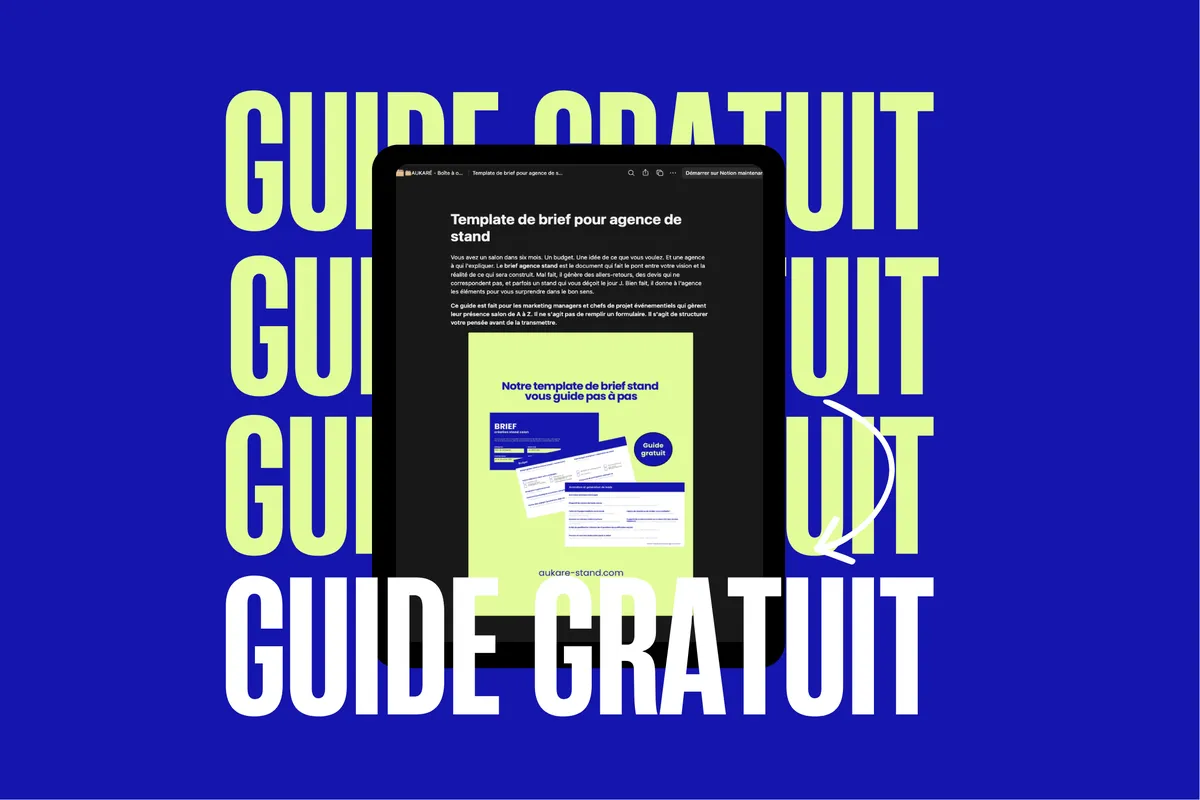
This guide is designed for marketing managers and event project managers who handle their trade show presence from A to Z. It’s not about filling out a form; it’s about structuring your thoughts before you share them.
Prefer to get straight to work? Download our ready-to-use booth brief template, which you can fill out in under an hour.
Download the free guide !
An agency without a structured brief has to work based on assumptions. They design a booth that matches their interpretation of your project, not necessarily yours. The result: mounting revisions, missed deadlines, and a sense of mutual frustration.
According to feedback from booth design agencies, more than 60% of back-and-forth during the design phase is linked to elements the client failed to formalize in their initial brief: brand tone, sales team requirements, or simply what they didn't want.
A good brief is time invested upfront to save ten times as much later on.
It aligns internal stakeholders before you even contact an agency. It reduces room for interpretation. It speeds up the design phase. It allows you to compare multiple quotes on an apples-to-apples basis. And most importantly, it gives the agency the material they need to do truly relevant creative work.
A comprehensive brief reduces the number of approval cycles by an average of 30 to 40% between the first draft and final approval. On a 6 to 12-week project, that’s the difference between a booth delivered with peace of mind and one finalized 10 days before the event.
Our booth brief template guides you step-by-step through 6 essential sections. The result: a clear, comprehensive document ready to send to your agency.
Download the free template.
The basic information every agency needs to know
Before any creative work begins, the agency must understand the context in which the booth will exist. Which trade show? What date? What size? What configuration (island, inline, corner, peninsula)? How many open sides?
These elements define the project's architectural constraints. A 12 m² inline booth and a 36 m² island booth do not follow the same design rules. The agency cannot work without this information.
Beyond the trade show: what really matters to you this year
Is this your first time at this show or your tenth? Are you looking to acquire new clients, retain existing ones, launch a new product, or recruit? These goals do not lead to the same type of booth. A lead generation booth is not designed the same way as a product demonstration booth or a VIP meeting space.
Also, specify the competitive landscape. Do you know who is exhibiting next to you? Which companies in your sector will be there? This information guides creative choices and your visual differentiation strategy.
To learn more about defining your trade show goals: Read our article on price per m² and how to calibrate your booth investment
"Attracting visitors" is not a goal. "Qualifying 80 leads over the 3 days of the show" is. The difference isn't just cosmetic: it dictates the booth design, space planning, the space allocated to the sales team, and the contact capture tools to be integrated.
According to the annual study byUNIMEV for French B2B exhibitors, 68% of exhibiting companies do not set quantified goals before the trade show. And among them, 74% retrospectively feel that their participation did not meet their expectations. This correlation is no coincidence.
In your brief, specify the number of team members present at the booth, their roles (reception, demonstration, negotiation), and the visitor flow you anticipate. A booth for 2 sales reps managing 5 people simultaneously has different spatial requirements than a booth with 1 person.
Also specify the planned features: live product demos, presentation screens, private meeting areas, or interactive kiosks. These elements take up space and must be integrated during the design phase, not added afterward.
The brand guidelines are the foundation. But a good creative brief goes further. It provides the agency with visual references (photos of booths that impressed you, brand worlds, moods), key elements to highlight (flagship product, team, tagline), and things to avoid.
The "what we don't want" section is often the most useful. It prevents the agency from heading in a direction you would have rejected immediately, even if you hadn't anticipated it. Take the time to fill it out.
A booth is not an isolated object. It is the physical extension of your brand in a highly competitive visual environment. Think about the message you want a visitor to remember 30 seconds after walking past your booth without stopping. This message must be readable from 5 meters away.
Read our article: custom vs. modular booths: what's the difference and how to choose based on your positioning
It is the most avoided topic in briefs, yet the most defining one. Many marketing managers hesitate to share their budget, fearing the agency will adjust its quote upward. It’s understandable. It’s also counterproductive.
An agency working without a budget range will present what they are capable of, not what is realistic for you. They will design a €30,000 booth when your budget is €15,000. The result: a quote you reject, a redesign phase, and wasted time for everyone.
Provide a range rather than a specific figure if you prefer to keep some room for negotiation. Specify what this budget covers: does it include transport and logistics? Assembly and dismantling? Storage between shows if the stand is reusable?
As a benchmark: stand construction accounts for an average of 35 to 50% of the total budget for participating in a trade show. The rest is split between floor space rental, pre-show communication, staff, transport, and accommodation. Framing the stand budget within this overall context helps you make better trade-off decisions.
Logistical constraints are often the first thing forgotten in a stand brief, yet they can invalidate entire architectural choices. Specify: the show's technical regulations (maximum height, authorized materials, floor load capacity), the assembly and dismantling deadlines set by the organizer, and access to the exhibition center.
If you have exhibited at this show before, provide the floor plan from the previous edition and your feedback. If it is your first time, request the technical manual from the organizer before briefing your agency.
A point often ignored in the brief: what happens to the stand after the show? If you exhibit several times a year, the question of storage, reusability, and modularity must be addressed from the brief, not after delivery. It fundamentally changes the design choices and the project's economic calculation.
Read our article: how to calculate the true cost of a stand across multiple shows
A brief without a "what we don't want" section is an incomplete brief. This section often contains the most useful information for an agency. Did you see a stand that put you off? Note why. Do you have a bias against a certain type of material, a way of laying out space, or a graphic style? Put it in writing.
These elements prevent entire creative directions that you would have rejected from the start. They save the agency time and reduce your frustration.
Have you specified the main message the stand should communicate? Have you listed the 3 non-negotiable elements for you on this project? Have you communicated your internal constraints (management approval, validation deadlines, number of client-side stakeholders)? Have you provided visuals, logos, and brand guidelines in usable formats?
Evaluate the responses based on three criteria: understanding of your brief (did they grasp what you are looking for?), creative relevance (does the proposal serve your objectives?), and the rigor of the quote (are the line items clearly detailed?).
A structured brief is the key to a successful booth. The brief is not just administrative paperwork. It is the foundational step of your booth project. The more structured it is, the more accurately your vision is conveyed. The more accurately your vision is conveyed, the more the finished booth will match what you had in mind. And a booth that matches what you had in mind is a booth that serves your business objectives.
Define the trade show and the stakes. Set quantified business objectives. Convey your brand identity. State the budget clearly. List logistical constraints. Say what you don't want. These six steps don't take much time. They save you a lot more.
Are you still here? Good news. We’ve got more to share with you. Short, to-the-point articles, written for those who are preparing for a trade fair and setting up their stand but don’t have time to read novels.





@2026 AUKARÉ all rights reserved.